[Stay on top of transportation news: Get TTNews in your inbox.]
Schneider CEO Filter hopeful over supply-driven upcycle
Driver availability, operating costs and regulatory barriers restrict the supply response
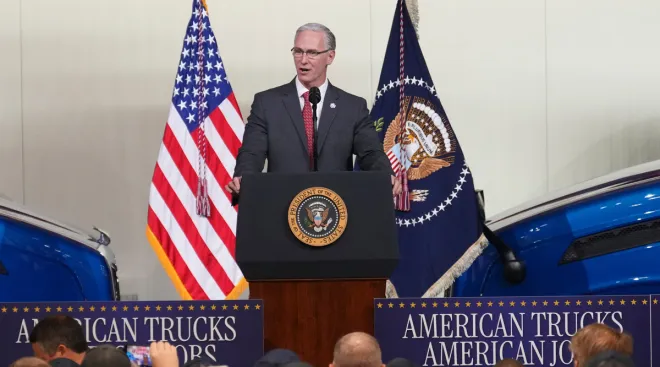
 “We believe third-quarter freight volume activity reflected typical seasonality and some normalization of inventory patterns rather than a deterioration of underlying demand,” Schneider CEO Jim Filter said. (Schneider)
Key Takeaways:
- Schneider CEO Jim Filter said capacity constraints and regulatory enforcement support a trucking upcycle despite softer third-quarter freight activity.
- Schneider’s third-quarter net income rose to $49.5 million from $19.4 million as revenue increased 9% to $1.59 billion.
- Filter expects further rate recovery as noncompliant capacity exits and customers adjust to higher costs for dependable multimodal capacity.
Schneider CEO Jim Filter is optimistic capacity corrections will further drive trucking into a freight market upcycle.
The Department of Transportation escalated a decline in trucking capacity when it stepped up enforcement against questionable drivers starting in late 2025. The industry was already grappling with an oversupply of capacity from the coronavirus-era freight market boom.
“The supply thesis remains intact,” Filter said on an investor call Oct. 29. “Though capacity attrition occurred at a more measured pace than what we experienced in the first half of the year, we are continuing to see an overall constrained supply picture.”
RELATED: Schneider turns to homegrown CEO Jim Filter for its next era
Filter added that this constrained supply is happening despite a general rise in spot rates over the past year, with capacity still hampered by driver availability, elevated operating costs and increased barriers to entry. He sees trends that are anticipated to support additional rationalization.
“Regulatory enforcement efforts are ongoing in areas such as entry-level driver training and electronic logging devices,” Filter said. “These actions should improve driver qualification and hours-of-service compliance and make it more difficult for irrational capacity to enter or remain in the market. At the same time, fuel costs have increased meaningfully.”
Filter added that driver wages are on the rise as well, and smaller carriers are facing increasing economic pressure. He noted that these dynamics together are limiting the ability of supply to respond to improving pricing conditions. He expects supply to behave rationally as noncompliant capacity exits the market and the industry moves further through what he views as an upcycle.
RELATED: Small trucking companies file 221 bankruptcies in 2026
“While supply dynamics remain constructive, freight activity saw a modest step back versus second quarter, a reflection of anticipated seasonal patterns,” Filter said. “Consumer spending remained resilient overall, though this varied by category. Higher interest rates and affordability constraints continue to weigh on certain key end markets, such as housing and automotive.”
Filter made his remarks while presenting third-quarter financial results for 2026. The Green Bay, Wis.-based truckload motor carrier posted net income of $49.5 million, or 28 cents a diluted share. That compared with $19.4 million, 11 cents, during the same time the previous year. Total operating revenue increased 9% to $1.59 billion from $1.45 billion.
“We believe third-quarter freight volume activity reflected typical seasonality and some normalization of inventory patterns rather than a deterioration of underlying demand,” Filter said. “As a result, spot rates also moderated during the quarter.”
Schneider Q3 2026 Earnings Report
Filter pointed out that while the decline was greater than traditional seasonal patterns, it came after a strong period earlier in the summer. But he noted that spot rates began to improve toward the end of the quarter, while contract pricing continued to advance. He said he’s seeing growing recognition from customers over the need for solid multimodal capacity.
“[This] is further reinforcing our view that pricing recovery remains intact,” Filter said. “As such, we expect additional rate recovery as customers continue to adjust to the higher underlying cost of dependable capacity.”
Results by segment
Truckload revenue increased to $624.8 million from $624.5 million. Income from operations increased 121% to $43.7 million from $19.8 million.
Intermodal revenue increased 2% to $287.7 million from $281.4 million. Income from operations increased 35% to $22.6 million from $16.8 million.
Logistics revenue increased 12% to $372.5 million from $332.1 million.
Schneider ranks No. 10 on the Transport Topics Top 100 list of the largest for-hire carriers in North America and No. 18 on the TT Top 100 list of the largest logistics companies. It also ranks No. 50 on the TT Top 50 list of the largest global freight companies.