
[Stay on top of transportation news: Get TTNews in your inbox.]
Higher truck demand leads to Paccar Q3 supply chain hiccups
Freight market rebound sees truck maker miss sales forecast
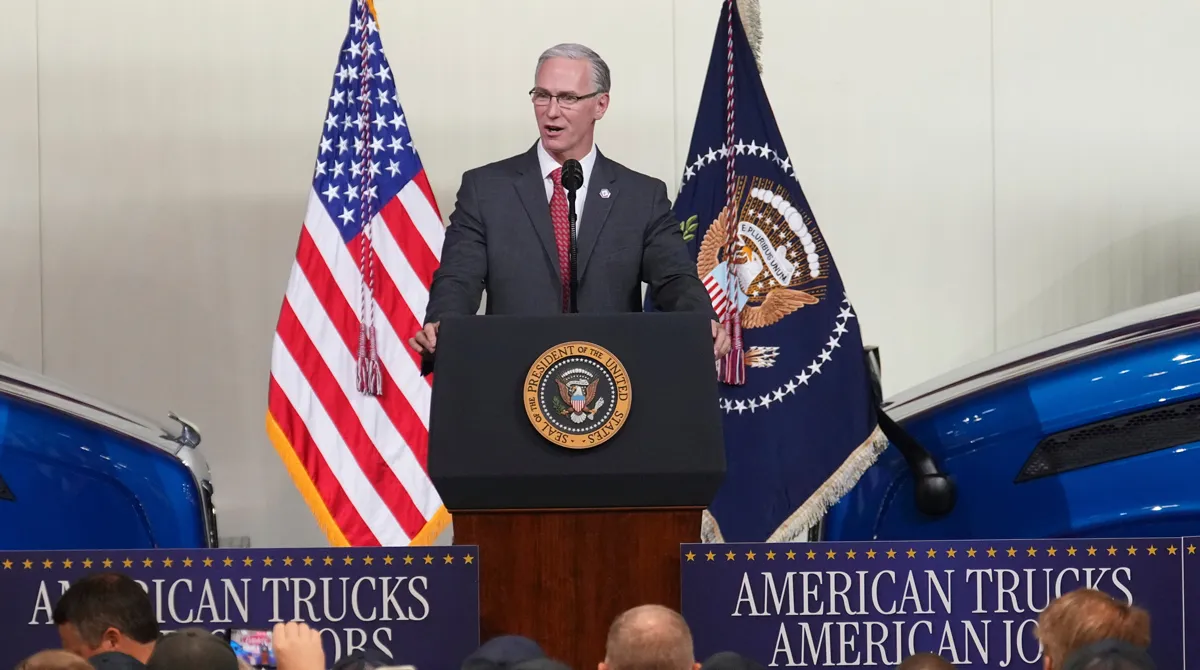 Feight speaks during President Trump’s visit to a Peterbilt plant Oct. 1. (Tony Gutierrez/Associated Press)
Key Takeaways:
- Paccar delivered 40,100 trucks globally in the third quarter, below its expected 42,000 as supply chain issues constrained production.
- Deliveries rose 25.7% year over year, while Paccar reported Q3 net income of $847.5 million on $7.94 billion in revenue.
- Paccar expects fourth-quarter deliveries of 41,000 to 43,000 trucks as supplier performance improves and freight market demand strengthens.
Supply chain issues meant Paccar Inc. fell short of its expected truck delivery levels in the third quarter of 2026, CEO Preston Feight said Oct. 27.
The top executive at the parent company of Kenworth and Peterbilt said suppliers were unable to scale up their output at the same pace as demand for trucks grew following the North American freight market rebound.
“The easiest way to think about it at the macro level is build rates have gone up significantly, and they’ve gone up rather quickly, and that just puts a tax on the system. We have great suppliers. They do a good job of working with us,” Feight said.
“It’s just expecting them to go up this quickly in support of the total industry has created some work for them and a few misses. All you have to do is miss a single part on a truck and it becomes impactful. Almost all of them are performing really well, but all it takes is one or two missed parts to make it meaningful,” he added.
However, Feight told analysts during Paccar’s third-quarter 2026 earnings call that those previously undisclosed problems are likely to become less significant in the current quarter.
Bellevue, Wash.-based Paccar’s global truck deliveries totaled 40,100 units in Q3, an increase of 25.7% compared with 31,900 in the year-ago period and also a 3.6% rise compared with 38,700 in the second quarter of 2026.
But Paccar had expected global third-quarter 2026 sales to grow to around 42,000 vehicles.
Looking forward, Paccar anticipates fourth-quarter 2026 deliveries will be between 41,000 and 43,000 vehicles.
“We’re working closely with our suppliers to make sure they get the parts to us so we can build trucks. Makes it a lot easier to build the trucks when we got the parts,” Feight said. “Our teams are working closely with them, and we’re making great progress, hence the guide for higher deliveries in Q4.”
Peterbilt, for one, anticipated being able to build more trucks. The company’s Denton manufacturing plant in Texas has added more than 1,000 employees in 2026. The hiring spree continues and mirrors ongoing head count additions at the truck maker’s peers on the back of the freight market recovery and increased sales.
Paccar truck sales in the U.S. and Canada in the most recent quarter totaled 23,800 vehicles, an increase of 39.2% compared with 17,100 in the same period a year earlier and 8.2% compared with 22,000 trucks in Q2 2026.
Feight said growing demand for trucks led to a busy meeting schedule at American Trucking Associations’ 2026 Management Conference & Exhibition, held Oct. 17-20 in Charlotte, N.C.
“I think we’re sitting at a transition point where the fleets would like to be growing. They’re still managing cash flow. They’ve seen costs be high with fuel, so fuel increases the cash flow problem for them. They’re managing driver costs. That’s a cash flow impact to them. They’d like to be growing their businesses,” Feight told analysts.

PCS Software CEO Mark Hill discusses the advance of AI in the trucking industry. Tune in above or by going to RoadSigns.ttnews.com.
“Some of them are starting to see that ability, but it’s really just beginning to be there. There’s been some consolidation over the past few years. It’s taking some absorption of fleet size into the market that’s now finishing. It makes it feel like they’ll begin to see increases in fleet size in the coming quarters,” he added.
As a result, Paccar estimates the 2026 U.S. and Canadian Class 8 market will be between 240,000 and 260,000 trucks, and between 240,000 and 280,000 trucks in 2027. When releasing its second-quarter 2026 earnings, Paccar estimated 2026 sales would be in a range of 230,000 to 270,000 trucks.
Any uncertainty over demand in 2027 depends on demand for trucks that do not comply with the Environmental Protection Agency’s nitrogen oxide regulations.
Paccar, which revealed during its Q2 earnings that Kenworth and Peterbilt would offer both EPA 2024- and EPA 2027-compliant engines after Jan. 1, sees demand for the former.
“There is a strong demand for the 200-milligram engines, which we think carries into 2027 as well,” Feight said. “Every customer we meet with is much more interested in proven, stable technology that they’ve had time to vet in their operations.”
A truck with a 200-milligram engine incurs a nonconformance penalty from Jan. 1 onward, but truck makers are touting the regulatory mechanism as cheaper than a truck with a compliant engine.
Paccar posted net income of $847.5 million in Q3, an increase of 43.6% compared with $590 million in the year-ago period.
The company’s Q3 revenue totaled $7.94 billion, an increase of 19% compared with $6.67 billion a year earlier.


