
[Stay on top of transportation news: Get TTNews in your inbox.]
Oil prices swing after U.S. attacks Iran
Brent crude falls 0.9% to $103.80 a barrel
| Updated:
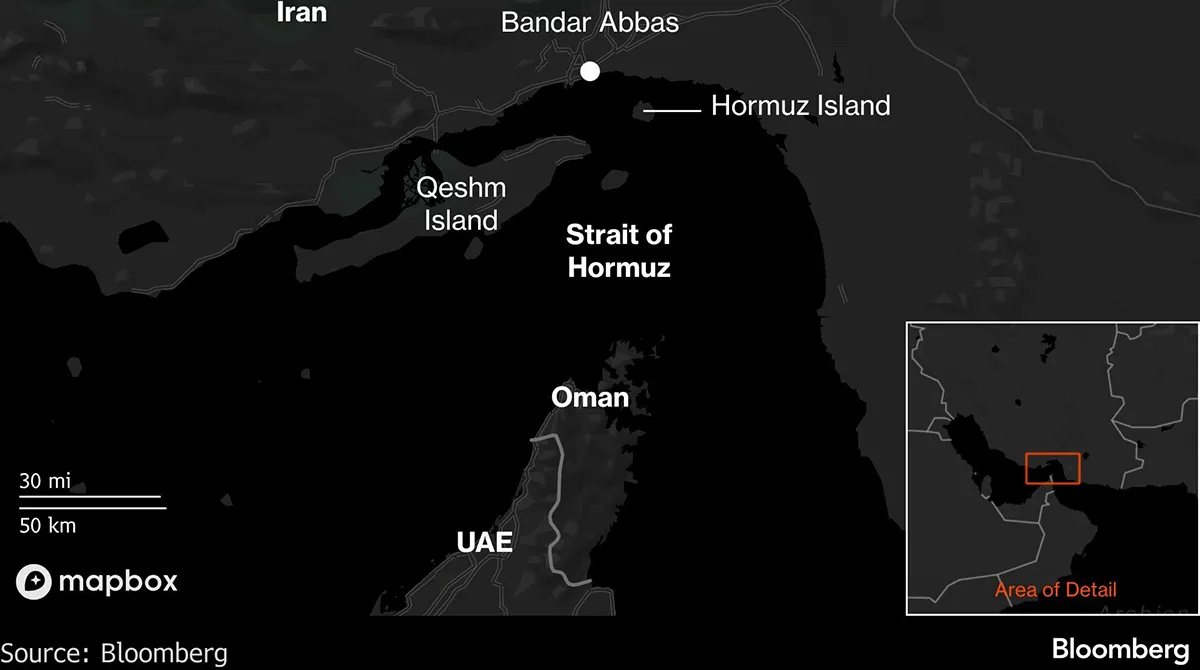 The U.S. struck targets on the Iranian island of Qeshm inside the Strait of Hormuz overnight. (Bloomberg)
Key Takeaways:
- Oil prices swung after a sharp retreat to start the week after the U.S. conducted defensive strikes on Iranian targets in the Strait of Hormuz.
- Energy prices have been extremely vulnerable due to uncertainty over when the war with Iran will end.
- The stock market was mixed on the day of the midterm elections and with concerns continuing to grow about the huge costs of expansion in the AI sector.
NEW YORK — The U.S. stock market is drifting in mixed trading on Nov. 3, with Apple falling but other Big Tech stocks picking up the slack following their own big swings.
In the oil market, prices continued to swing after the United States attacked Iran's Qeshm Island near the Strait of Hormuz. Brent climbed above $107 per barrel in the morning before briefly dropping below $101 on continued uncertainty about what will happen in the war with Iran. It was most recently down 0.9% at $103.80.
Energy prices have been extremely vulnerable due to uncertainty over when the war with Iran will end.
The S&P 500 added 0.2% in early trading, even though more stocks fell within the index than rose. The Dow Jones Industrial Average was down 232 points, or 0.4%, as of 9:35 a.m. Eastern time, and the Nasdaq composite was 0.5% higher.
The stock market has been shaky recently as technology and artificial intelligence stocks have swung on worries their prices shot too high in the frenzy around AI. Several of the most influential AI-related stocks held up better on Nov. 3, which supported the market, though they flipped from gains in the morning to losses in the afternoon a day earlier.
Nvidia rose 3.1% and was the strongest force pushing upward on the S&P 500 Tuesday. CoreWeave rose 2.6%. The company that’s borrowed money to buy AI chips that it rents out to customers over the cloud has been at the center of the industry’s swings recently.
Apple was long seen on Wall Street as a Big Tech company that’s less dependent on AI. But it’s still feeling the effects of the AI boom.
Bright flashes light up the night sky before loud explosions erupt on Iran's Qeshm Island, near the Strait of Hormuz. Eyewitness footage released Tuesday captures the blasts as a U.S. official confirms American forces carried out what were described as limited, defensive strikes on the island. Iranian state media also reports several explosions, while a U.S. official says the operation does not signal a return to major combat operations. See what Trump says about his next potential target and follow the latest updates on Fox News: https://t.co/s2q2eDyOaz
— Fox News (@FoxNews) November 3, 2026
Memory chips for computers have become more expensive because of the demand created by the rush to build AI data centers. Those additional expenses are hitting Apple, which said it expects to make less profit from each $1 of its revenue during the final three months of this year.
That helped send Apple’s stock down 3.4%, even though the seller of iPhones and Mac computers reported stronger profit and revenue for the latest quarter than analysts expected.
Palantir Technologies fell 4.2% even though it likewise reported a better profit than expected. The software company said it made more money from working with U.S. companies than from the U.S. government for the first time, as U.S. commercial revenue soared 148% from a year earlier.
The Nov. 3 midterm elections may also be keeping financial markets unsteady, but history suggests that they may not matter much for the broad market. Going back to 1970, the S&P 500 has had a positive return in the six months following a midterm election every time, according to Brock Weimer, an analyst at Edward Jones.
Image

Some on Wall Street worry that a Democratic sweep of Congress this time around could lead to more regulations and restrictions on AI development. But Donald Trump would still be president and have the power to veto. And Wall Street generally prefers split control of Washington, which it sees as offering less risk of transformative policies that could reshape the economy.
On the winning side of Wall Street were stocks of several companies that reported stronger profits for the summer than analysts expected.
Celanese climbed 4.9%, and DuPont added 7%.
Expectations are high for all kinds of companies to continue to deliver big gains in profits as the U.S. economy keeps chugging along, even with high inflation and elevated interest rates. That helped send the S&P 500 to a record high last month.
In stock markets abroad, indexes were mixed across Europe and Asia. South Korea’s Kospi dropped 3.6% for one of the world’s sharpest moves following losses for its two tech giants, Samsung Electronics and SK Hynix.
Stocks rose 0.3% in Australia after the country’s central bank raised its benchmark interest rate for the fifth time this year.
AP Writers Elaine Lai, David McHugh and Rod McGuirk contributed to this report.


