[Stay on top of transportation news: Get TTNews in your inbox.]
Mexican truckers seek diplomatic talks over revoked visas
Drivers held 4-day protest at U.S.-Mexico crossing
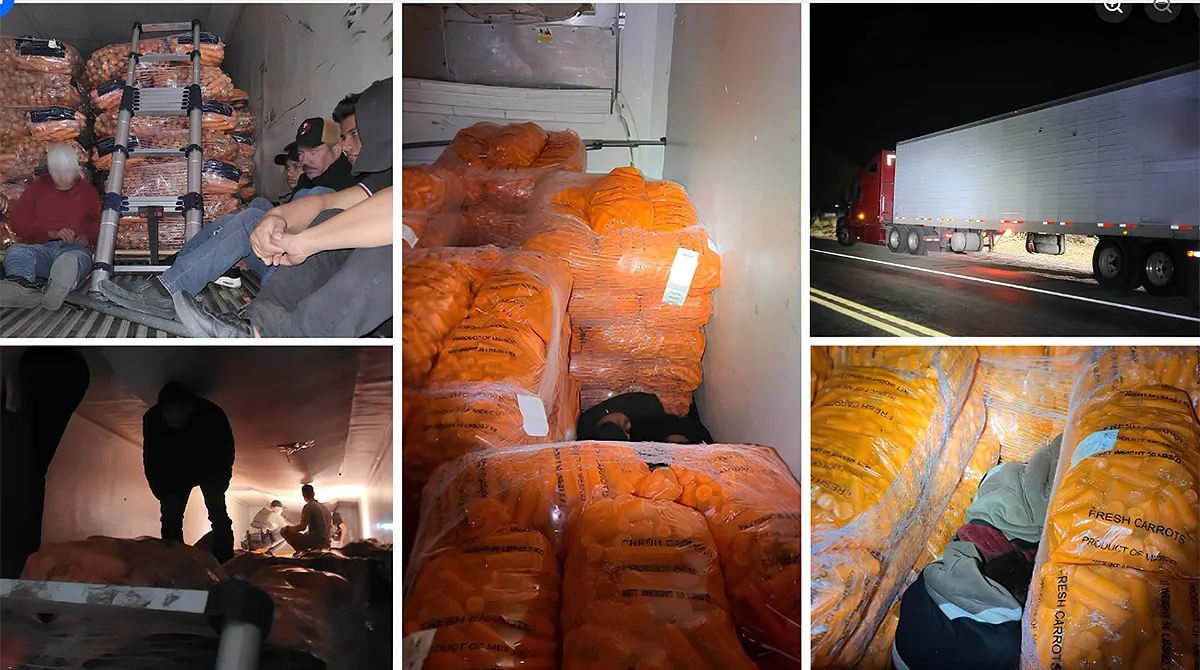 CBP agents stopped an unidentified Mexican truck driver near Nogales, Ariz., who was hauling a trailer loaded with pallets of carrots. Agents found 11 undocumented migrants in the trailer. (U.S. Border Control via Facebook)
Key Takeaways:
- A four-day truck blockade at the Calexico East border crossing followed visa revocations tied to alleged U.S. cabotage violations involving Mexican drivers.
- Enforcement increased after DOT shared three years of cabotage data with border authorities, enabling electronic checks that industry reports link to more visa revocations.
- Baja California trucking representatives plan talks with Mexican ministries and U.S. consular officials while Congress considers a cabotage study in surface transportation legislation.
A four-day truck blockade at the California-Mexico border led to intensified tensions over U.S. cabotage enforcement, compelling Baja California trucking representatives to seek diplomatic talks after hundreds of Mexican drivers reportedly lost visas this year.
Border-area news outlets reported that anywhere from several hundred to thousands of Mexican truckers have lost visas over alleged cabotage violations, though U.S. Customs and Border Protection has not released an official figure.
Cabotage is defined as Mexican or Canadian drivers who remain in the U.S. after making cross-border deliveries to haul domestic freight. Drivers from those countries may enter the United States on valid visas to transport international freight, but federal cabotage laws prohibit them from hauling domestic loads reserved for U.S. carriers.
“CBP enforces U.S. immigration laws to protect the legitimate trucking industry, ensure fair competition, and support safe freight movement. Regarding the recent protest activity, the event was localized to the Calexico East Port of Entry and concluded over the weekend,” a CBP spokesperson told Transport Topics. “CBP does not comment on individual visa cases or enforcement actions. Visa-related enforcement matters are reviewed based on the facts and circumstances of each case and applicable law.”
Federal cabotage enforcement escalated this year after the U.S. Department of Transportation shared three years’ worth of violation data with border authorities. That information now can be checked electronically, allowing CBP officers to identify past offenders before they cross into the U.S. The data-driven approach has led to more visa revocations, according to industry reports, because officers no longer primarily must physically inspect trucks to uncover violations. But it also has aggravated some cross-border drivers.
On Sept. 3, 17 Mexican truckers had their visas permanently revoked in a single day at the Mexicali crossing opposite the Calexico East commercial cargo crossing, according to border-area news reports. In response, drivers formed a blockade that halted commercial vehicle entries at the port. Some truckers alleged that visas were revoked for violations that did not occur.
The four-day protest disrupted operations at the crossing and affected Mexican carriers attempting to move freight into the U.S. Local media reported that trucks were stranded in the area and unable to cross during the port’s normal operating hours of 6 a.m. to 10 p.m.
“During this period, the primary impact on the U.S. side was traffic congestion, which was managed through coordination with local law enforcement to redirect outbound traffic. CBP also extended operating hours at the Otay Mesa Port of Entry to alleviate cargo backlogs,” the CBP spokesperson said.
“Alien truck drivers with B-1 non-immigrant visas may only transport cargo in international commerce; engaging in cabotage violates non-immigrant status and may result in visa cancellation or revocation,” the spokesperson added.
Image
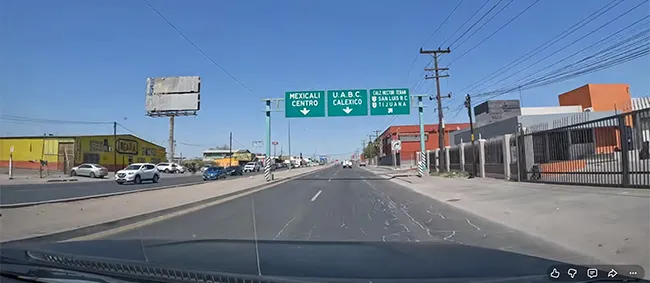
Dashcam photo approaching the Calexico East Port of Entry. (Smart Border Coalition via YouTube)
After the protest, Baja California officials and Mexican trucking representatives said they planned to raise truckers’ allegations with Mexico’s Economy and Foreign Affairs ministries and seek discussions with U.S. consular officials, according to the Imperial Valley Press.
Transport Topics contacted the State Department to confirm reports of possible meetings in Mexico City regarding concerns raised by the Mexican truckers. No response had been received at press time.
Meanwhile, CBP continues to publicize cabotage enforcement cases as warnings to drivers. In one recent example, CBP agents stopped an unidentified Mexican truck driver near Nogales, Ariz., who was hauling a trailer loaded with pallets of carrots. Agents found 11 undocumented migrants in the trailer.
“The driver, a Mexican citizen here on a visitor visa, faces charges for human smuggling and cabotage violations,” Tucson CBP said. “Human smugglers continue to treat lives as cargo. Agents remain committed to disrupting these operations.”
Possible congressional action
As enforcement activity continues along the southern border, cabotage violations also are drawing attention in Washington.

Arpan Podduturi of Samsara examines how AI, telematics and onboard cameras are converging to protect drivers and reduce risk. Tune in above or by going to RoadSigns.ttnews.com.
The issue could emerge as a point of discussion during Congress’ debate over the next surface transportation reauthorization measure.
A Congressional Research Service report released Sept. 11, Surface Transportation Reauthorization: Commercial Trucking Issues, identified cabotage enforcement as a potential federal policy issue.
Included in HR 8870, the BUILD America 250 Act — a bipartisan surface transportation reauthorization proposal covering fiscal years 2027-31 — is a requirement for a DOT study of cabotage violations. If enacted, the measure would require the transportation secretary to, within one year, provide a Transportation Research Board report examining the safety and economic effects of cabotage violations. The study would seek input from law enforcement agencies, labor organizations, commercial motor vehicle drivers, owner-operators and trucking industry groups.