[Stay on top of transportation news: Get TTNews in your inbox.]
Logistics CEO: Hormuz rerouting will raise consumer prices
DP World leader Yuvraj Narayan says prolonged disruption is raising logistics costs
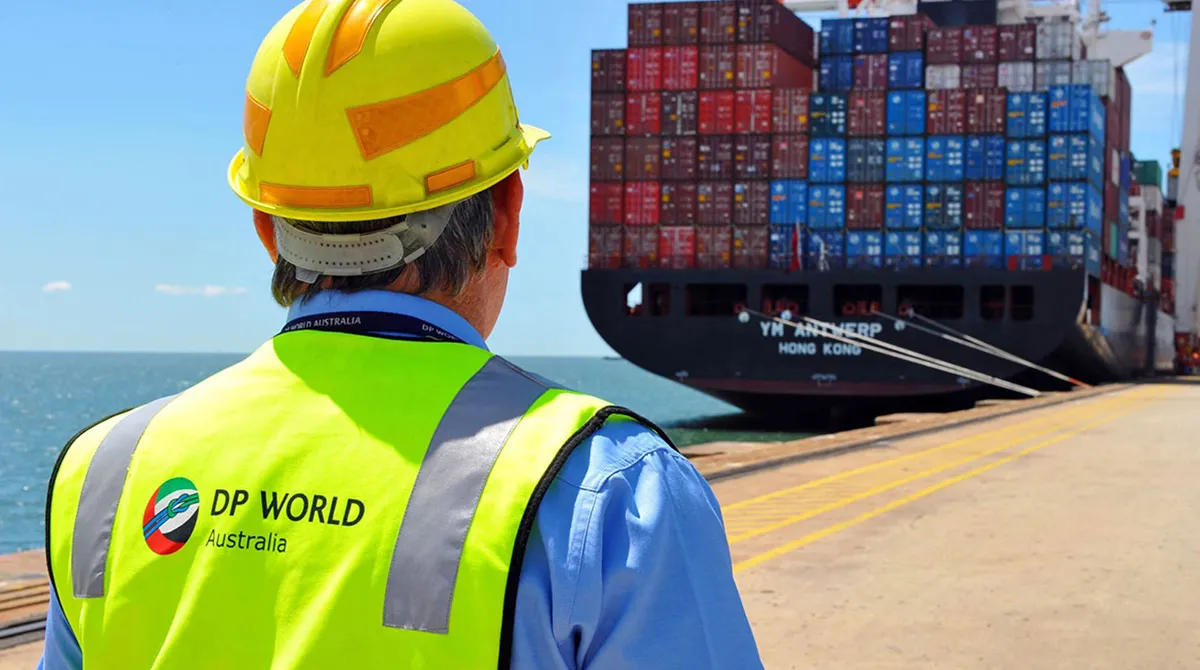 An employee at the DP World container berth at the Port of Brisbane, Australia. (Eric Taylor/Bloomberg News)
Key Takeaways:
- DP World CEO Yuvraj Narayan warned prolonged Strait of Hormuz disruption is raising logistics costs and could drive consumer prices higher worldwide.
- DP World moves more than 3,000 containers daily by truck near Jebel Ali, while normal terminal volume is about 40,000 containers.
- Xeneta does not expect prewar container shipping networks to return soon, while Narayan urged investment in spare capacity to strengthen trade resilience.
The head of DP World is sounding the alarm about inflation pressures from a lengthy disruption to Mideast trade, warning that rewiring supply chains to avoid the Strait of Hormuz will eventually boost consumer prices far beyond the Persian Gulf region.
DP World Group CEO Yuvraj Narayan said the Dubai-based port and logistics giant’s new truck networks are moving more than 3,000 containers a day for the nearly 12,000 companies operating in the free zone near its Jebel Ali port. Normally, the terminals there would handle about 40,000 containers a day.
The diversions are necessary because vessels that used to arrive regularly carrying as many as 24,000 containers are still wary of transiting Hormuz, where the attacks on the merchant fleet may worsen if U.S. military strikes resume after the midterm elections on Nov. 3.
DP World’s shift to slower, lower-volume logistics on land from the efficiencies of ocean shipping is proving expensive — four or five times more costly in some instances, Narayan said. Cargo owners can only manage those through tighter margins and inventory buffers for so long before they’ll look to charge more.
“You can’t absorb that indefinitely,” he said in written responses to questions from Bloomberg News. “The longer disruption persists, the greater the likelihood that higher costs feed through into prices, at a time when households are already living with elevated prices and central banks are trying to return inflation to target.”
Narayan took the helm of DP World two weeks before the war started. He’s now drawing attention to an issue overshadowed by concerns about energy supplies and oil price volatility: that Hormuz is also an established maritime crossroads for merchandise trade between Asia, Europe, Africa and the U.S.
Key crossroads
Among the more than 60 ports DP World operates around the world is its flagship Jebel Ali, the busiest container hub outside of Asia. It is connected to an industrial hive of warehouses, distribution centers and factories that logged trade in 2024 valued at $190 billion — roughly equal to Chile’s annual exports and imports.
Image

DP World Group CEO Yuvraj Narayan. (Anindito Mukherjee/Bloomberg)
While alternative trucking routes to reach the free zone from other United Arab Emirates gateways like Fujairah and Khor Fakkan are improving, an underutilized Jebel Ali means a loss of the benefits of scale, speed and proximity.
“Once you start replacing sea miles with road miles, the economics change very quickly,” Narayan said. “Port disruption might be local, but the bill is global.”
He also responded to U.S. Treasury Secretary Scott Bessent’s remarks in early September that Hormuz “will be like a worthless piece of water” in two years because oil can be rerouted easily to avoid the war-torn waterway.
“He’s right that you can put oil through a pipeline. But you can’t put global trade through a pipeline,” Narayan said. “Can you find another port? Of course. Can you find another route? Yes. Can you re-create Jebel Ali somewhere else? No. That would take decades and billions of dollars.”
Image
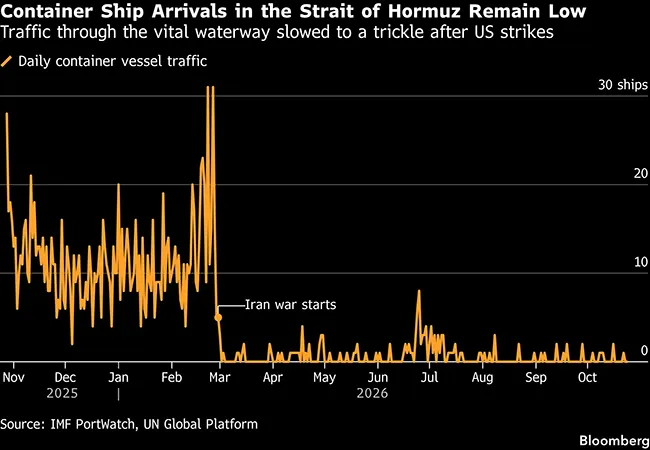
Before the war started in February, about 100 container shipping services were transiting Hormuz or operating within the Gulf, according to Xeneta, a digital freight platform based in Oslo. Those numbers have plunged and the few that remain are almost exclusively carrying trade between Iran and China, said Peter Sand, Xeneta’s chief analyst.
“We’re not expecting a return of pre-war container shipping networks anytime soon,” Sand said.
Xeneta’s data show spot rates as of Oct. 23 to send a 40-foot container from China to ports in the Gulf region have surged since the war started, including a 214% increase to Jeddah, Saudi Arabia, and a 442% jump to Khor Fakkan in eastern UAE.
Narayan said governments and private investors have a big role to play in the establishing a more shock-resistant global trading system and rethinking the economics of infrastructure.
“For decades everybody wanted maximum utilization and minimum spare capacity. That’s very efficient when everything works,” Narayan said. “But resilience means having some capacity you may not need every day.”
‘Advantage carrier’ era
Container lines will be among the winners in a world where seaborne trade is in a regular state of disorder, according to shipping industry analyst John McCown. He dubbed the boom times for maritime cargo since August 2020 the “advantage carrier” era that’s seen three phases.

Bob Toews, CEO of TruckDown, discusses winter readiness in the connected fleet era. Tune in above or by going to RoadSigns.ttnews.com.
First came the pandemic surge in goods trade, then the tightening of capacity when ships were forced to avoid the Red Sea starting in late 2023.
“We are in a third ramp-up phase where a prime catalyst is the Iran situation,” McCown wrote in an October research note. “Carriers have learned to benefit from these distortions which typically result in higher earnings.”
Container rates over the past six years have averaged $3,026 per 40-foot unit, compared with $1,624 in the decade leading up to the pandemic, according to Drewry’s World Container Index composite of major east-west trade routes.