[Stay on top of transportation news: Get TTNews in your inbox.]
Daimler Truck, Volvo push hydrogen-fueling ecosystem at IAA
OEMs eye continentwide aid as Radstrom seeks penalty delays
 Radstrom and Lundstedt in October 2024. (Daimler Truck)
Key Takeaways:
- Daimler Truck and Volvo Group joined technology, energy and infrastructure companies to advance hydrogen fueling infrastructure in Germany.
- Company executives said hydrogen and battery-electric trucks are both needed to help achieve European decarbonization targets.
- The coalition is seeking government support to expand hydrogen infrastructure development across Europe.
HANNOVER, Germany — Truck manufacturers whose four North American brands accounted for a combined 58.3% of U.S. Class 8 sales in the first eight months of 2026 are teaming up with technology and energy companies to build out Germany’s hydrogen fueling infrastructure.
Daimler Truck and Volvo Group on Sept. 15 said they were partnering with Toyota Motor Corp., Bosch, Air Liquide and TotalEnergies in the latest example of the two companies’ ambitions to globally advance trucks with hydrogen powertrains.
Fueling infrastructure specialists Teal Mobility and MB Energy also are part of the coalition’s pursuit of accelerating the commercialization of hydrogen-powered trucking and the ecosystem needed.
Both Daimler Truck and Volvo Group have plans for hydrogen fuel cell electric and hydrogen internal combustion engine trucks.
Details on the coalition’s initial plans for building out the hydrogen infrastructure ecosystem were thin on the ground at its unveiling at the IAA Transportation conference, but Daimler Truck CEO Karin Radstrom warned that electric trucks wouldn’t be enough to meet internal and European Commission decarbonization targets.
“At Daimler Truck, we’re convinced that we need both electric and hydrogen trucks to decarbonize Europe. Firstly, because hydrogen trucks have a longer range … and obviously there is a payload advantage as well because you’re not carrying so much batteries,” Radstrom said.
The executive added that to transition Europe’s 6 million trucks away from diesel — which saw record prices in Germany this week as a result of conflicts in the Ukraine and Middle East — to battery-electric powertrains would require all the electricity Germany consumes.
“This is not some small side project for us. It’s a very important part of our strategy. But to make hydrogen trucks work, it obviously takes more than just trucks,” she said. “And with hydrogen, unlike with the ramp up of electric trucks, we want to build the entire ecosystem from the start. From the vehicles to the refueling systems to having competitive TCO.”
Image
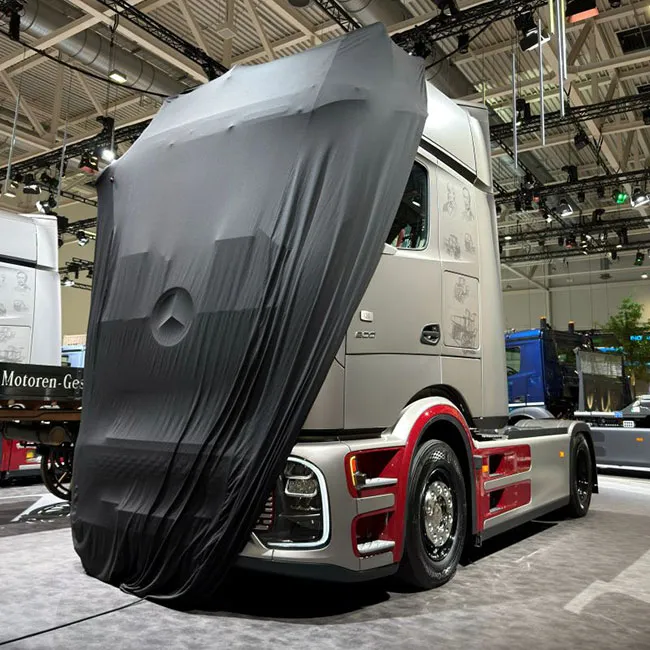
Mercedes-Benz Trucks’ NextGenH2 hydrogen fuel cell electric tractor at IAA Transportation. (Daimler Truck AG via LinkedIn)
Daimler Truck — parent company of Freightliner and Western Star — publicly showcased Mercedes-Benz Trucks’ NextGenH2 hydrogen fuel cell electric tractor at IAA Transportation for the first time. A total of 100 NextGenH2 trucks will be built at the Worth plant by the end of 2026 as part of the first small series production run for the model. Series production of the fuel cell trucks is targeted for the early 2030s.
In June, Daimler Truck said it was teaming up with Keyou to begin offering tractors with hydrogen-fueled internal combustion engines as early as 2027, with a focus on European markets. The resulting tractor, the Keyou HICE.40, is set to operate with a range of up to 650 kilometers or just over 400 miles.
Volvo Group CEO Martin Lundstedt stood shoulder to shoulder with Radstrom at the launch and noted: “We are not picking winners at this point in time. We are firm and fully subscribed to Karin’s analysis here that we need all of these technologies to be successful. But we need them at scale, and we need corporations, and we need a synchronized uplift when it comes to the ecosystem.”
Lundstedt added, “Reality always beats theory. And we need to adapt to a world where a lot of different factors will compete here. When we can get down, and that is our analysis at Volvo, to a price point of 6 euro per kilogram in Europe, then we have the business case going.”
The hydrogen ambitions of Gothenburg, Sweden-based Volvo Group — the parent company of Volvo Trucks North America and Mack Trucks — include its hydrogen ICE joint venture Cespira and the Cellcentric fuel cell JV with Daimler Truck.
The German government is backing the coalition’s ambitions, promising both a framework and funding. But the coalition wants European authorities to follow in the footsteps of the continent’s largest economy and Daimler Truck’s homeland.

Arpan Podduturi of Samsara examines how AI, telematics and onboard cameras are converging to protect drivers and reduce risk. Tune in above or by going to RoadSigns.ttnews.com.
“While Germany serves as the operational launchpad, demonstrating how industry action and targeted public support can accelerate market development, the [coalition calls for] strategic measures — supported by national governments and the European Commission — to replicate this model at a continental scale,” Daimler said.
Radstrom told a separate audience at IAA that Daimler Truck wants European authorities to push back deadlines for decarbonization.
European customers are slow rolling investment in zero-emission trucks — as their North American counterparts have to an even greater extent — due a lack of infrastructure and cost parity with diesel.
By 2030, the carbon dioxide emissions of newly registered heavy-duty trucks must be 43% lower than in 2019, with considerable penalties if the targets are not met.
“For every percentage that we potentially miss the target, we could face around euro 120 million in penalties,” Radstrom warned. “And say we missed the target by just 10%, so we reached 33% better CO2 in the fleet than in 2019. That would mean we’d have to pay $1.2 billion.”